Meditation for beginners: 5 simple exercises for everyday life
Meditation is not a technique you “get done” but a practice you keep returning to. Regina, our teacher, has meditated since the age of twelve. These five exercises are a good start — five minutes a day is enough.

What meditation is — and is not
Meditating does not mean thinking of nothing. It means directing your attention deliberately to something — the breath, the body, a sound — and kindly returning to it when it wanders. Thoughts keep coming. You simply learn not to follow every one of them.
What research says
According to the US National Center for Complementary and Integrative Health (NCCIH), studies suggest that meditation and mindfulness programmes may help with stress, anxiety and symptoms of depression. Study quality varies, and meditation is not a substitute for medical or psychological treatment.
Exercise 1: Counting breaths
Sit upright, eyes closed or half open. Count each out-breath: one, two, three … up to ten, then start again. If you lose count, begin at one. No frustration — coming back is the exercise.
Exercise 2: Body scan
Move your attention slowly through the body: feet, legs, pelvis, belly, chest, shoulders, arms, neck, face. Notice what is there — warmth, tension, tingling — without trying to change anything. Good in the evening before sleep.
Exercise 3: Walking meditation
Walk very slowly, ten steps there, ten back. Feel the heel touch the ground, the weight roll forward, the foot lift. Ideal when sitting still is hard — and possible on every walk in the woods.
Exercise 4: Repeating a mantra
Choose a short word or syllable, such as “Om” or “calm”. Repeat it silently in rhythm with the breath. Mantras give the mind something to do and are one of the oldest forms of meditation in the yogic tradition.
Exercise 5: Open awareness
Sit still and rest your attention on nothing in particular. Notice whatever arises — sounds, thoughts, sensations — and let it pass like clouds. This is easier once you have practised the others for a while.
Common obstacles
- “I have no time”: link the practice to something you already do — after brushing your teeth, before your first coffee.
- “I get restless”: try walking meditation or shorten it to three minutes.
- “I fall asleep”: sit more upright or practise in the morning.
Going deeper on a retreat
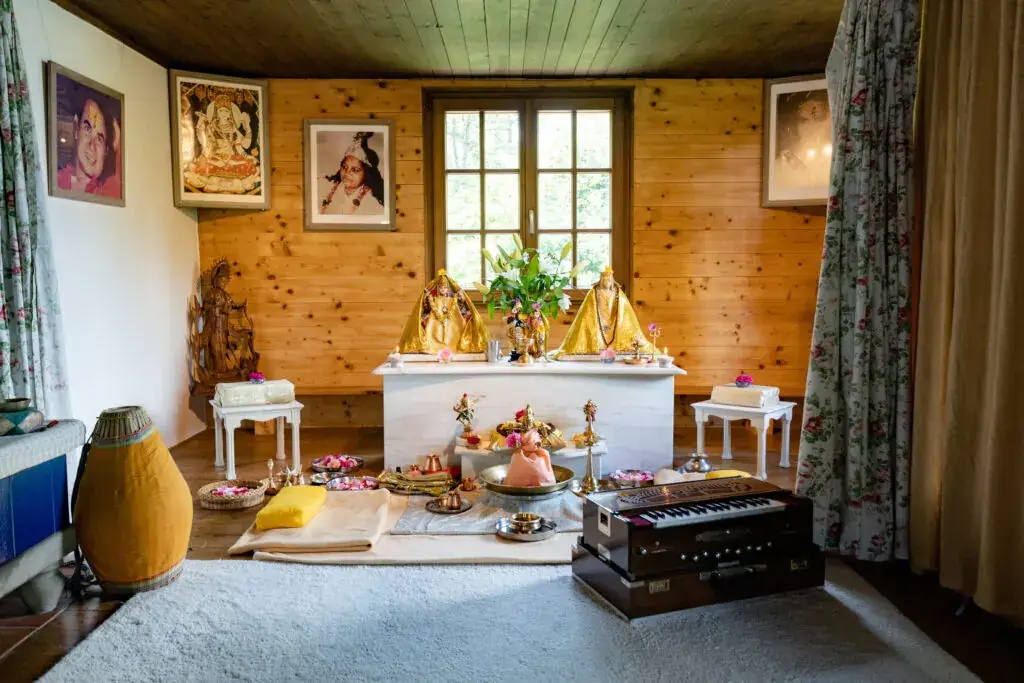
Alone at home, meditation often stays at five minutes. In a group, in a quiet place and with guidance, it is easier to sit longer. On our retreats every day begins with meditation — at the Schweibenalp, in the temple.
Frequently asked questions
How long should a beginner meditate?
Five to ten minutes a day is a good start. Regularity matters more than length.
Do I have to sit in lotus position?
No. A chair or a cushion is fine. What matters is an upright, relaxed posture.
When is the best time to meditate?
Many people practise in the morning before the day starts. The best time is the one you actually use.